 Dost Pakistan Journeys Tours and safaris in the North & South Pakistsn
“`html
Submarine Cable Fault: A Deep Dive into Pakistan’s Internet Connectivity Challenge
ISLAMABAD – Pakistan’s digital landscape recently experienced a jolt as a fault in the critical SEA-ME-WE 5 (SMW5) international submarine cable system threatened intermittent internet disruptions across the nation. The Pakistan Telecommunication Authority (PTA) has swiftly responded, monitoring the situation and coordinating efforts to mitigate the impact, highlighting the ever-present vulnerabilities and the crucial need for robust digital infrastructure.
The Latest: Navigating Internet Disruption in Pakistan
The Pakistan Telecommunication Authority (PTA) has confirmed that it is actively monitoring disruptions stemming from a technical fault within the SEA-ME-WE 5 (SMW5) international submarine cable system. This crucial infrastructure component, vital for much of Pakistan’s internet traffic, is experiencing an issue that could lead to intermittent degradation in service quality and connectivity for users nationwide.
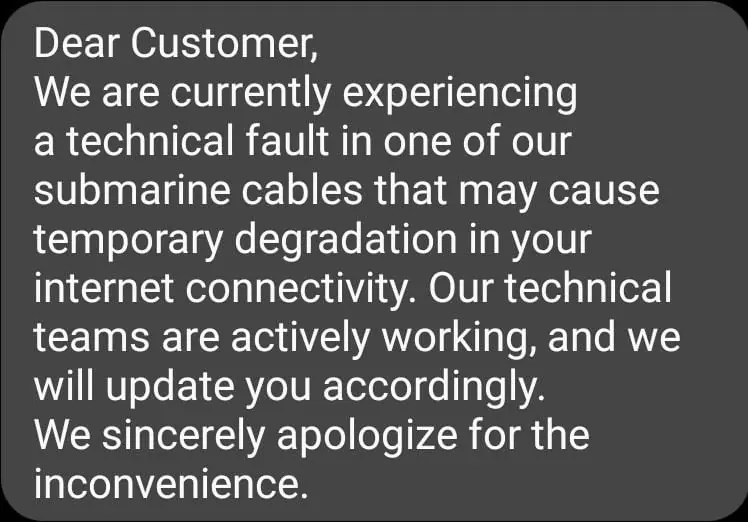
Transworld Associates (TWA), a key private-sector operator with exclusive ownership of submarine fibre-optic cable systems in Pakistan, is spearheading coordination with the SMW5 consortium. Their immediate objective is to pinpoint the exact cause of the fault and establish a timeline for its complete restoration. In the interim, to minimise user impact, internet traffic is being intelligently rerouted through alternative international links, striving to maintain service continuity as much as possible. TWA has also directly communicated with its customers via SMS, acknowledging the “technical fault” and assuring them of ongoing efforts by their technical teams.
The PTA has reassured the public of its close coordination with all relevant stakeholders, pledging continuous monitoring of the situation until full resolution.
Understanding the Internet’s Underwater Lifelines
To grasp the significance of a fault in the SMW5 cable, it’s essential to understand the intricate world of submarine fibre-optic cables. These aren’t merely wires; they are the unseen arteries of the global internet, responsible for carrying over 99% of international data traffic. Stretching for thousands of kilometres across ocean floors, these cables connect continents, enabling everything from real-time communication and financial transactions to streaming entertainment and cloud computing.
The SEA-ME-WE (South-East Asia–Middle East–Western Europe) series of cables are consortia-owned systems that form a critical backbone for connectivity between Asia, the Middle East, and Europe. SMW5, in particular, plays a vital role in channelling a substantial portion of Pakistan’s internet traffic, linking it to the wider global network.
Despite their robust construction, these underwater marvels are susceptible to various threats. Common causes of faults include accidental damage from ship anchors and fishing trawlers, seismic activity on the ocean floor, and even natural wear and tear over decades of service. Repairing these cables is a complex, time-consuming, and expensive undertaking, often involving specialized cable-laying ships and remotely operated vehicles (ROVs) descending to great depths.
In Pakistan, the Pakistan Telecommunication Authority (PTA) acts as the primary regulatory body, overseeing the country’s telecommunications sector, including internet infrastructure. Transworld Associates (TWA) stands out as a unique private-sector player, owning exclusive submarine cable systems, making it a critical provider for Pakistan’s international internet gateway.
Impact on Pakistan: Digital Vulnerability and Steps Towards Resilience
The recent SMW5 fault underscores Pakistan’s reliance on a limited number of international gateways for its digital connectivity. Such disruptions, even if intermittent, can have cascading effects across various sectors:
- Economic Impact: Businesses heavily reliant on internet connectivity – from e-commerce and IT services to financial institutions and remote workforces – can face significant operational hurdles, leading to potential revenue losses and decreased productivity.
- Social Disruption: Individuals experience slower browsing, interrupted streaming, and difficulties in online communication, affecting education, healthcare services, and daily social interactions.
- Service Quality Degradation: While rerouting traffic helps, it often comes at the cost of increased latency (delays) and reduced bandwidth, diminishing the overall quality of internet service for end-users.
However, this incident also highlights proactive measures being taken to enhance Pakistan’s network resilience. A significant development in November saw the landing of the new South-East Asia–Middle East–Western Europe 6 (SEA-ME-WE 6) submarine internet cable in Pakistan. This state-of-the-art cable boasts a total capacity exceeding 100 terabits per second, with Pakistan allocated a substantial 13.2 terabits per second.
The SEA-ME-WE 6 system is designed with “more fibre pairs and more than double the capacity” of its predecessors, offering enhanced resilience and diversification. Crucially, its trans-Egypt geo-diversified crossings and multiple landing points across high-traffic Asia-Europe routes are intended to minimise the impact of faults in any single segment or cable, offering a robust backup.
Analysis: Future-Proofing Pakistan’s Digital Horizon
The SMW5 incident serves as a stark reminder of the inherent vulnerabilities in global internet infrastructure. No nation, regardless of its technological advancement, is entirely immune to the physical realities of deep-sea cables. For Pakistan, a developing nation heavily investing in its digital economy, such internet disruptions carry significant weight.
The swift action by PTA and TWA to reroute traffic demonstrates an effective immediate response strategy. This quick thinking and operational agility are crucial in managing such crises and minimizing the ripple effect across the economy and society. However, the long-term solution lies in bolstering network redundancy and diversification. This is precisely where the strategic importance of projects like SEA-ME-WE 6 comes into play.
The new SEA-ME-WE 6 cable is not just an incremental upgrade; it represents a significant leap forward in Pakistan’s connectivity strategy. By providing one of the lowest-latency routes and offering substantial additional capacity, SEA-ME-WE 6 will not only improve general internet service quality but, more importantly, act as a vital safeguard against future outages. Its diversified routing options mean that if one cable segment fails, traffic can be seamlessly shifted to another, drastically reducing the chances of a nationwide blackout and enhancing overall network resilience.
Investing in such robust digital infrastructure is paramount for ‘Digital Pakistan’ initiatives. Reliable, high-speed internet is no longer a luxury but a fundamental necessity for sustained economic growth, fostering innovation, attracting foreign investment, and ensuring social inclusion. As the world increasingly shifts towards cloud computing, AI, and big data, the demand for uninterrupted, high-bandwidth connectivity will only intensify.
While the immediate focus remains on restoring SMW5, the incident reinforces the ongoing need for continuous investment in a multi-layered, resilient internet infrastructure. Pakistan’s journey towards a truly digital future depends on building and maintaining these critical underwater lifelines, ensuring that temporary faults do not translate into long-term setbacks for its rapidly expanding digital landscape.
“`
