Dost Pakistan Journeys Tours and safaris in the North & South Pakistsn
Related Articles

“`html
Pakistan’s Historic Return to IMF and World Bank Chairmanship: A New Chapter in Global Economic Influence
Pakistan is poised to take a prominent role on the global economic stage, having been announced as the incoming chair of the Boards of Governors of the International Monetary Fund (IMF) and the World Bank Group (WBG) for 2027. This significant development, marking Pakistan’s return to the chairmanship for the first time since 1953, signals a potential shift in its international standing and offers a unique platform for advocacy in global economic discourse.
The News
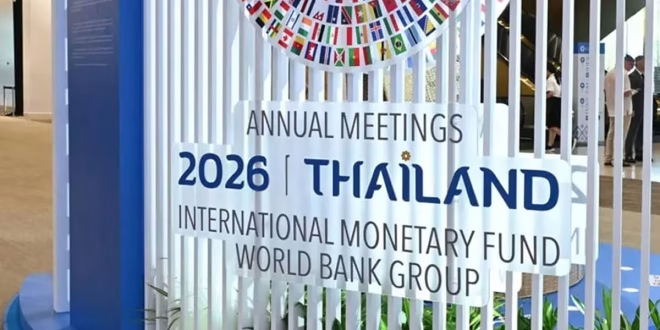
The Ministry of Economic Affairs confirmed that Federal Minister for Economic Affairs Ahad Khan Cheema, who also serves as Pakistan’s governor to the World Bank, was formally declared the incoming chair during the plenary session of the 2026 WBG-IMF Annual Meetings in Bangkok. This announcement comes amidst the annual gathering of over 15,000 participants, including central bank governors, economic policymakers, and business leaders from 191 countries, discussing the world economy.
The ministry hailed this as a “historic milestone,” emphasizing the opportunity it provides Pakistan to contribute meaningfully to global economic and development discussions, fostering constructive dialogue among member countries. Minister Cheema received briefings on the responsibilities of the chairmanship and engaged with key WBG officials, including Vice President and Corporate Secretary Aradhana Kumar-Capoor, to discuss institutional support. He also met with Carlos Carvallo Spalding, governor of Paraguay’s central bank and the outgoing chair, to exchange views on the role’s priorities.
Significantly, Cheema underscored Pakistan’s commitment to “strengthening the voice of developing countries,” advocating for effective and predictable development financing, enhanced coordination among multilateral development institutions, and mobilizing private capital for sustainable, inclusive growth. Meanwhile, Finance Minister Muhammad Aurangzeb, leading Pakistan’s delegation, held high-level engagements with various international financial institutions and policymakers, a crucial aspect given Pakistan’s ongoing engagement with the IMF for substantial financial facilities, including a $7 billion Extended Fund Facility (EFF) and a $1.4 billion Resilience and Sustainability Facility (RSF).
Background: Understanding the IMF, World Bank, and the Chairmanship Role
To fully grasp the significance of Pakistan’s upcoming role, it’s essential to understand the institutions it will chair and the nature of the position itself:
- The International Monetary Fund (IMF): Established in 1944, the IMF is an organization of 190 countries, working to foster global monetary cooperation, secure financial stability, facilitate international trade, promote high employment and sustainable economic growth, and reduce poverty around the world. It primarily provides financial assistance to countries facing balance of payments problems, often with conditions requiring economic reforms.
- The World Bank Group (WBG): Also founded in 1944, the WBG is a family of five international organizations providing financial and technical assistance to developing countries. Its mission is to reduce poverty and support development. It offers loans, credits, and grants to governments for projects such as infrastructure, education, health, and environmental protection.
- Boards of Governors: These are the highest decision-making bodies of both the IMF and the World Bank. Each member country appoints a governor (usually the Minister of Finance or the head of the central bank) and an alternate governor. The Boards typically meet once a year during the Annual Meetings to discuss global economic issues, policy directions, and the strategic vision for the institutions.
- The Chairmanship: The role of the Chair of the Boards of Governors is largely facilitative and ceremonial. The Chair presides over the plenary sessions of the Annual Meetings, guides discussions, and acts as a representative figure for the Boards. While not directly dictating policy, the Chair can influence the agenda, highlight specific issues, and foster dialogue, thereby enhancing the visibility and potential influence of their country on the global economic stage. For Pakistan, a nation with a long and often challenging history of engagement with both institutions as a frequent borrower, this chairmanship represents a profound shift in its relationship.
Impact on Pakistan: Prestige, Advocacy, and Potential for Reform
Pakistan’s assumption of the IMF and World Bank chairmanship in 2027 carries multifaceted implications, both symbolic and potentially substantive:
- Elevated Global Profile and Prestige: This appointment significantly boosts Pakistan’s international standing. It signals a level of trust and recognition from the global financial community, showcasing Pakistan as a responsible and engaged member capable of contributing to global economic governance, despite its ongoing domestic economic challenges. This prestige can translate into greater diplomatic leverage and influence in other international forums.
- A Powerful Platform for Advocacy: The chairmanship offers a unique opportunity for Pakistan to champion the interests and concerns of developing countries, often referred to as the Global South. Minister Cheema’s stated commitment to “strengthening the voice of developing countries” and advocating for predictable development financing, climate change adaptation funding, and better coordination among multilateral institutions aligns perfectly with this platform. Pakistan can use its position to highlight critical issues like debt sustainability for low-income nations, equitable access to capital, and reform of the international financial architecture.
- Enhanced Dialogue and Networking: Presiding over these high-level meetings facilitates unparalleled networking opportunities with finance ministers, central bank governors, and economic policymakers from nearly 200 nations. This can open doors for bilateral cooperation, attract foreign investment, and foster a deeper understanding of Pakistan’s economic context and potential among global decision-makers.
- Incentive for Domestic Economic Reforms: While the chairmanship doesn’t directly solve Pakistan’s economic woes, it creates an implicit incentive for the country to demonstrate robust economic governance and reform. A Pakistan that is stable and actively pursuing sustainable growth would lend more credibility and weight to its advocacy on the global stage. Progress on its current IMF programs, for instance, would bolster its image as a credible voice for economic stability.
- Boosting National Morale: In a country often grappling with economic uncertainties and external perceptions, this historic appointment can be a significant morale booster, fostering national pride and a renewed sense of purpose on the international stage.
Analysis: Beyond Symbolism to Strategic Influence
While the role of Chair of the Boards of Governors is often described as largely ceremonial, its symbolic power and potential for strategic influence should not be underestimated. For Pakistan, this appointment transcends mere recognition; it’s an opportunity to redefine its narrative and exert meaningful impact.
Firstly, the symbolism is potent. For a nation that has frequently sought assistance from the IMF and World Bank, moving into a leadership role demonstrates a maturation of its engagement and a recognition of its importance as a stakeholder in the global financial system. It positions Pakistan not merely as a recipient, but as a facilitator of global dialogue and problem-solving.
Secondly, the platform for advocacy is where Pakistan can truly make its mark. In an era marked by complex global challenges—from climate change-induced economic shocks to persistent debt crises in developing nations—the need for a more responsive and equitable multilateral system is paramount. Pakistan, having experienced many of these challenges firsthand, possesses a unique perspective to articulate the needs of vulnerable economies. Its commitment to mobilizing private capital for sustainable growth is particularly relevant, aligning with global efforts to bridge financing gaps for development projects.
However, the effectiveness of Pakistan’s chairmanship will undoubtedly be intertwined with its domestic economic performance. The credibility of its voice on global financial stability and development will be amplified if Pakistan can demonstrate progress on its own economic reform agenda. Continuing its engagement with the IMF, securing stability, and implementing policies that foster sustainable and inclusive growth will provide a strong foundation for its leadership role.
In conclusion, Pakistan’s upcoming chairmanship of the IMF and World Bank Boards in 2027 is more than just a ceremonial honour; it is a strategic opportunity. It offers a unique window to elevate its global standing, champion the cause of developing nations, and contribute constructively to shaping the future of the international financial architecture. The world will be watching to see how Pakistan leverages this historic milestone to drive meaningful change and solidify its position as a proactive force in global economic governance.
“`