Dost Pakistan Journeys Tours and safaris in the North & South Pakistsn
Related Articles

“`html
Pakistan’s Zeeshan Ali in Tiangong: A New Dawn for Space Diplomacy and Bilateral Ties
The Historic Voyage: Zeeshan Ali Boards Tiangong
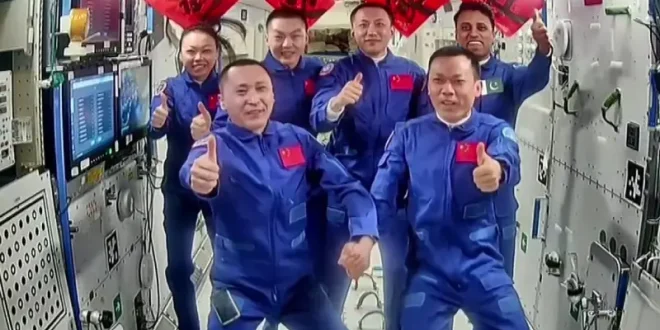
In a landmark event for both Pakistan and China, Pakistani pilot and astronaut Zeeshan Ali made history on Wednesday as he became the first foreign national to board China’s Tiangong Space Station. Launched aboard the Shenzhou-24 mission from the Jiuquan Satellite Launch Centre, Ali, a 40-year-old payload specialist, docked with the orbital outpost alongside Chinese crew members Commander Tang Hongbo and flight engineer Wu Yi. This monumental achievement not only propels Pakistan’s nascent space ambitions but also signifies a strategic expansion of Beijing’s international space diplomacy.
Ali’s journey to orbit followed seven months of rigorous training in Beijing, encompassing not only specialized astronautics but also intensive Chinese language and cultural immersion, including poetry, calligraphy, and even table tennis. Upon entering the Tiangong module, the Shenzhou-24 crew received a warm welcome from the existing three-member Shenzhou-23 team, complete with celebratory cake and group photographs, marking the ninth such orbital rendezvous in Chinese aerospace history. During his 5-to-10-day stay, Ali is slated to conduct various scientific experiments, including research on microalgae cultivation and the effects of spaceflight on quinoa seeds, highlighting the practical scientific benefits of this collaboration. Notably, the station crew prepared a specially curated halal food menu, featuring traditional Pakistani dishes, underscoring China’s commitment to cultural consideration in its space endeavors.
Background: Forging a Celestial Alliance
The successful integration of Zeeshan Ali into the Tiangong Space Station crew is not an isolated incident but rather the culmination of years of strategic partnership and ambition. To understand its full scope, one must look at the broader context of both China’s independent space program and the enduring “ironclad friendship” between Beijing and Islamabad.
China’s Independent Space Ascent
China’s journey to establish its own orbital outpost, Tiangong (meaning “Heavenly Palace”), was largely driven by its exclusion from the US-led International Space Station (ISS) due to geopolitical tensions and legislative restrictions. This pushed China to develop a robust, independent space program, characterized by rapid advancements in rocketry, crewed missions, and modular space station construction. Tiangong, fully operational since late 2022, represents a formidable capability, allowing China to host long-duration missions and conduct extensive scientific research. More than just a scientific platform, Tiangong serves as a powerful symbol of China’s technological prowess and its readiness to establish its own international partnerships in space.
Pakistan’s Stellar Ambitions
For Pakistan, the dream of human spaceflight has been a long-held aspiration. The national space agency, Suparco (Space and Upper Atmosphere Research Commission), founded in 1961, has historically focused on satellite development and applications. However, sending a Pakistani astronaut into orbit marks a significant leap, transforming abstract ambitions into tangible reality. This mission aligns with Pakistan’s broader goals of fostering scientific temper, inspiring its youth towards STEM fields, and developing indigenous technological capabilities, even if the initial step is taken through international collaboration.
The “Ironclad Friendship” Extends to Orbit
The collaboration for Zeeshan Ali’s mission is a natural extension of the deep-rooted strategic and economic ties between China and Pakistan. Their relationship, often termed an “all-weather strategic cooperative partnership,” is exemplified by projects like the China-Pakistan Economic Corridor (CPEC). This mission underscores the profound trust and cooperation that transcends terrestrial boundaries, now reaching into outer space. Leaders from both nations, including Pakistani Prime Minister Shehbaz Sharif and President Asif Ali Zardari, have emphatically highlighted this aspect, viewing the space flight as another testament to their unwavering bilateral bond.
Impact on Pakistan: A Nation’s Hopes Take Flight
Zeeshan Ali’s spaceflight carries profound implications for Pakistan, resonating across its scientific community, youth, and national identity:
- Unprecedented National Pride and Inspiration: The mission has ignited widespread national pride. Prime Minister Shehbaz Sharif articulated this sentiment, stating that the journey was “not just that of one astronaut but of 240 million Pakistanis.” This event serves as a powerful inspiration for younger generations to pursue careers in science, technology, engineering, and mathematics (STEM), symbolizing that even ambitious dreams are attainable.
- Advancement in Scientific Capabilities: While conducted aboard Tiangong, the planned experiments by Ali, such as cultivating microalgae and testing quinoa seeds, directly contribute to Pakistan’s scientific research agenda. This collaboration facilitates knowledge transfer, allows Pakistani scientists access to a cutting-edge space laboratory, and builds expertise within Suparco for future indigenous space projects.
- Enhanced Global Standing: By becoming the first foreign nation to send an astronaut to China’s Tiangong Space Station, Pakistan elevates its profile in the international space community. This achievement positions Pakistan as a significant partner in emerging space initiatives, demonstrating its commitment to space exploration and scientific collaboration on a global scale.
- Reinforcement of Bilateral Ties: The mission serves as a potent symbol of the enduring “ironclad friendship” between Pakistan and China. It extends their strategic partnership into a new domain – outer space – further solidifying political, economic, and technological cooperation. This mutual support reinforces the narrative of a shared future and collective advancement.
- Human Capital Development: The rigorous training undergone by Ali (and Khurram Daud, who also trained) represents a significant investment in Pakistani human capital. This expertise, once brought back to Earth, can be leveraged to mentor future scientists and engineers, fostering a culture of high-level scientific inquiry and innovation within the country.
Analysis: Beyond the Orbit – China’s Growing Space Diplomacy
Zeeshan Ali’s presence on Tiangong is far more than a simple bilateral space mission; it’s a critical marker in the evolving landscape of international space cooperation and China’s assertive stride in space diplomacy. This event provides valuable insights into Beijing’s strategic vision for its space program and its global influence.
Pioneering a New Era of Space Collaboration
For years, the International Space Station (ISS) has been the primary symbol of international collaboration in space, albeit largely dominated by Western nations, with China notably excluded. Tiangong, born out of this exclusion, now offers an alternative platform for countries interested in human spaceflight and scientific research without being tethered to the geopolitical considerations that might prevent them from joining Western-led initiatives. By hosting Zeeshan Ali, China effectively signals its willingness and capability to lead a new multilateral space consortium, potentially reshaping the future of global space exploration.
“This mission is not a finish line; it is a launch pad. And I hope the next chapter of China-Pakistan space cooperation will grow from one astronaut, one flight to multiple joint flights, to the Moon, Mars and beyond.” – Zeeshan Ali
This statement by Ali himself perfectly encapsulates the long-term vision. China isn’t just offering a ride; it’s inviting partners to join a journey that extends “to the Moon, Mars and beyond.”
Strategic Soft Power and Influence
The mission serves as a powerful instrument of China’s soft power. By extending a hand in human spaceflight – a technologically demanding and high-prestige endeavor – China not only strengthens its existing alliances but also potentially attracts new partners. The meticulous attention to detail, such as providing halal food and cultural training, demonstrates a diplomatic nuance that enhances its global appeal. This gesture subtly positions China as a collaborative, inclusive, and capable leader in the peaceful exploration of space.
A Shifting Geopolitical Landscape in Space
The mission also highlights a potential bifurcation in global space cooperation. On one side, the US-led Artemis program is gathering allies for lunar exploration, largely comprising traditional Western partners. On the other, China’s Tiangong offers an alternative hub for nations, particularly those with strong existing ties to Beijing or those seeking pathways into human spaceflight that might be less accessible elsewhere. This dual-track development suggests a more diverse and perhaps competitive future for international space exploration, where different blocs may emerge around leading spacefaring nations.
Beyond Symbolism: Tangible Science and Future Prospects
While the diplomatic and symbolic significance is immense, the mission also underscores a commitment to tangible scientific outcomes. Ali’s role as a payload specialist performing specific experiments reinforces the practical, research-oriented nature of the Tiangong station. For Pakistan, this means direct participation in cutting-edge space science, providing invaluable experience that can feed into its own long-term aerospace strategy. The potential for future joint missions, possibly to the Moon as China plans a crewed lunar landing by 2030, represents an exciting frontier for the China-Pakistan alliance.
In essence, Zeeshan Ali’s voyage to Tiangong is more than just a personal triumph or a national milestone; it’s a microcosm of a larger story – the rise of China as a space superpower and its evolving strategy to shape the future of international space collaboration through diplomacy, partnership, and technological leadership.
“`