Dost Pakistan Journeys Tours and safaris in the North & South Pakistsn
Related Articles


“`html
Pakistan’s Fuel Price Freeze: A Strategic Pause Amidst Global Uncertainty
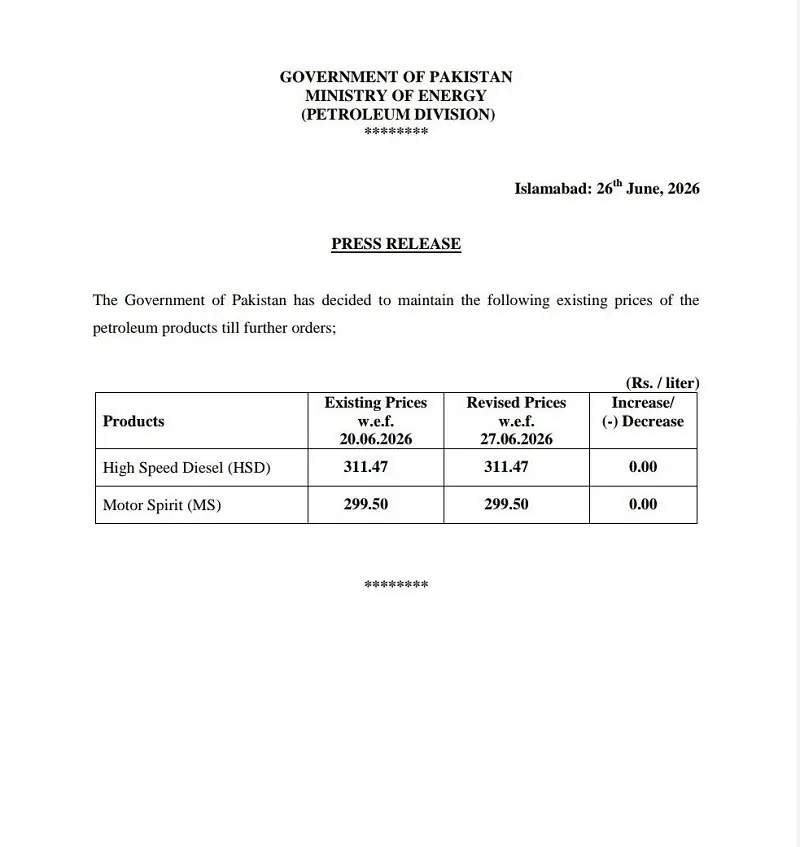
In a significant move, the Pakistani government has announced that petrol and high-speed diesel (HSD) prices will remain unchanged at Rs299.50 per litre and Rs311.47 per litre, respectively, “till further orders.” This decision, communicated by the Petroleum Division, follows a period of intense volatility in global oil markets and comes shortly after substantial price reductions were passed on to consumers. The stability aims to provide relief to various segments of society, from private transport users to heavy industries, against the backdrop of an ongoing energy crunch triggered by geopolitical tensions.
The News: A Halt to Weekly Revisions
The government of Pakistan, through its Petroleum Division, has confirmed that the prices of petrol and high-speed diesel (HSD) will not be revised for the foreseeable future. Petrol will remain at Rs299.50 per litre, and HSD at Rs311.47 per litre. This decision marks a departure from the weekly price adjustments that have become commonplace since geopolitical events began to roil global energy markets.
This period of stability comes on the heels of Prime Minister Shehbaz Sharif’s announcement last week, where consumers saw a significant relief with a Rs74 reduction in petrol prices and a Rs67 cut in HSD rates. These reductions were attributed to a decline in international oil prices, allowing the government to pass on the benefit directly to the public.
Background: Global Shocks and Domestic Adjustments
The current stability in Pakistan’s fuel prices is a direct response to, and a pause from, a turbulent period dominated by global energy market shocks. The catalyst for this volatility was the escalating US-Iran war, which led to the critical Strait of Hormuz blockade. This maritime chokepoint, through which a significant portion of the world’s crude oil passes, became a flashpoint, instantly triggering an “energy crunch” that reverberated across global markets, including Pakistan.
In response to this unprecedented instability, the Pakistani government began revising petroleum prices on a weekly basis every Friday night to reflect the rapidly changing international rates. This policy, while intended to align domestic prices with global trends, led to significant public outcry.
- March 6 “Inflation Bomb”: The initial wartime revision saw petrol and diesel prices hiked by Rs55 per litre, pushing HSD to Rs335.86 and petrol to Rs321.17 per litre. This move was widely condemned as an “inflation bomb,” exacerbating the economic woes of ordinary citizens.
- April 3 Peak and Swift Reversal: The situation worsened dramatically on April 3, when fuel prices reached their highest point. Petrol surged to Rs458.4 per litre and HSD to Rs520.35 per litre, following staggering hikes of Rs137.24 and Rs184.49, respectively. The unprecedented nature of these increases triggered immense public backlash. In an immediate response, Prime Minister Shehbaz Sharif intervened, slashing the petroleum levy by Rs80 per litre to bring petrol prices down to Rs378 per litre within 24 hours. This demonstrated the government’s sensitivity to public sentiment and its willingness to absorb some of the international price shocks through fiscal adjustments.
The petroleum levy is a government tax imposed on fuel, acting as a crucial revenue stream. While essential for fiscal health, it also serves as a flexible instrument that can be adjusted to either generate revenue or provide consumer relief, as seen during the April crisis.
Impact on Pakistan: Stabilizing the Economic Landscape
The decision to maintain current fuel prices has far-reaching implications across Pakistan’s economy and society:
- Consumer Relief and Inflation Control: For the general public, especially the middle and lower-middle classes, stable fuel prices offer much-needed predictability. Petrol is indispensable for private transport, small vehicles, rickshaws, and two-wheelers. Unchanged prices mean household budgets are less susceptible to sudden shocks, providing a temporary respite from persistent inflationary pressures. While previous hikes have already fueled inflation, a pause in increases can prevent further escalation and allow the economy to absorb past adjustments.
- Boost for Transport and Logistics: High-speed diesel (HSD) is the lifeblood of Pakistan’s heavy transport sector, freight, and public buses. Stable diesel prices directly translate into more predictable operating costs for transporters, potentially easing pressures on logistics and supply chains. This stability can help curb rising prices of essential goods, as transport costs are a significant component of product pricing.
- Agricultural and Industrial Support: Diesel is also crucial for power generation in many industrial units and for agricultural machinery. Consistent prices can support these vital sectors by providing a stable input cost, contributing to overall economic productivity and food security.
- Government’s Balancing Act: The government constantly navigates a delicate balance between fiscal responsibilities—including meeting revenue targets and adhering to international commitments like those with the IMF—and providing relief to its citizens. The decision to maintain prices, especially after recent cuts, suggests a prioritization of public welfare and economic stability over immediate revenue generation through the petroleum levy.
Analysis: A Strategic Pause in a Volatile World
The government’s decision to freeze fuel prices “till further orders” is more than a mere announcement; it represents a strategic pause in Pakistan’s economic management, reflecting a complex interplay of global events, domestic pressures, and political considerations.
Firstly, this move likely aims to provide a much-needed period of predictability. After months of weekly fluctuations and dramatic hikes and cuts, both consumers and businesses crave stability. By holding prices steady, the government signals an intent to allow the economy to absorb the recent significant price reductions and to foster a sense of calm. This could encourage economic activity, as businesses can plan with greater certainty regarding their operational costs.
Secondly, the phrase “till further orders” suggests the government is keenly observing the global oil market. While international prices recently declined, leading to the substantial cuts last week, the geopolitical landscape remains volatile. The situation in the Middle East, particularly the ongoing US-Iran tensions and the potential for renewed disruptions to the Strait of Hormuz, means future price surges are not out of the question. This pause allows Pakistan to assess the sustainability of current international prices before committing to further adjustments, giving it flexibility to react if global crude benchmarks rebound.
Thirdly, the government is acutely aware of the political ramifications of fuel prices. The “inflation bomb” backlash and the unprecedented hikes in April, which necessitated a swift reversal, underscore the public’s sensitivity. With an economy grappling with high inflation, any move that can alleviate public burden, or at least prevent its increase, is politically prudent. This decision could be seen as an effort to build goodwill and demonstrate a responsive governance approach, especially with potential political shifts or elections on the horizon.
However, the sustainability of this freeze depends heavily on external factors. If global oil prices begin to climb again, Pakistan will face a difficult choice: absorb the increases through subsidies (which strain the national exchequer and conflict with IMF conditionalities), reduce the petroleum levy further (sacrificing crucial revenue), or eventually pass on the hikes to consumers, risking renewed public discontent. The reliance on petroleum levy adjustments, while effective for short-term relief, highlights the need for a more comprehensive, long-term energy strategy to insulate Pakistan from global price shocks.
In essence, Pakistan’s decision to freeze fuel prices is a calculated measure designed to inject stability into an otherwise volatile economic environment. It’s a temporary reprieve, offering immediate relief and a chance for the government to recalibrate, while keeping a watchful eye on the unpredictable currents of the global energy market.
“`