 Dost Pakistan Journeys Tours and safaris in the North & South Pakistsn
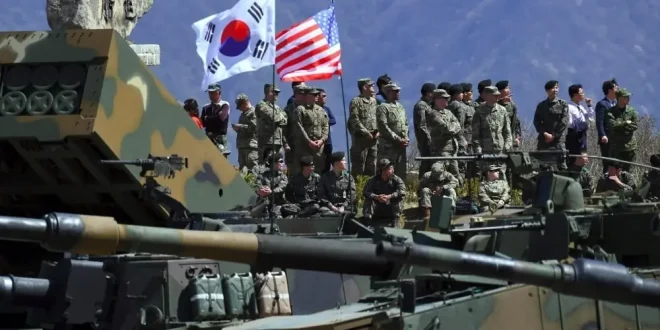
US-South Korea Tensions: The Geopolitical Dagger in Asia Amidst China’s Criticism
A diplomatic firestorm has erupted in East Asia following pointed remarks by the commander of US Forces Korea (USFK), Xavier Brunson. Describing South Korea as a “dagger in the heart of Asia” and a “fixed aircraft carrier” from China’s perspective, Brunson’s comments have drawn sharp condemnation from Beijing and prompted Seoul to engage in urgent talks with Washington. This incident illuminates the escalating geopolitical tensions in the Indo-Pacific and the delicate balancing act required by regional allies.
What Happened
General Xavier Brunson, commander of US Forces Korea, recently used evocative military metaphors to describe South Korea’s strategic positioning relative to China. In a podcast interview, he characterized South Korea as “the dagger in the heart of Asia” and previously referred to it as a “fixed aircraft carrier” – terms highlighting its critical role in regional defense. These statements quickly elicited a strong rebuke from the Chinese Embassy in Seoul, which accused Brunson of “truly crossing the line” and questioned if his “hostility and aggression” were authorized by Washington.
In response, South Korea’s presidential office confirmed it is in “communication at various levels” with the United States regarding the remarks, with local media reports suggesting Seoul had raised concerns multiple times in the past. The incident fuels ongoing speculation that the US might be looking to broaden USFK’s traditional role, moving beyond solely deterring North Korea to actively countering China’s growing influence in the broader Indo-Pacific.
Background: The Shifting Sands of Regional Strategy
The United States maintains a significant military presence of approximately 28,500 troops in South Korea, primarily established to deter aggression from nuclear-armed North Korea. This alliance, forged in the Korean War, has been a cornerstone of regional stability for decades. However, the geopolitical landscape of East Asia is evolving rapidly. Washington’s strategic focus has increasingly shifted towards great power competition, specifically addressing what it perceives as China’s assertiveness in the Indo-Pacific region.
From Beijing’s vantage point, the extensive US military presence and its network of alliances (with South Korea, Japan, the Philippines) represent an effort at containment, threatening its national security interests and regional ambitions. China views any expansion of USFK’s mandate to include countering its influence as a direct provocation. South Korea, caught between its vital security alliance with the US and its crucial economic partnership with China, finds itself in an increasingly precarious position. Its strategic location, bordering both the Yellow Sea and the East China Sea, undeniably makes it a critical piece in any regional power play, as Brunson’s metaphors inadvertently highlighted.
Why It Matters: Alliance Dynamics and Regional Stability
Brunson’s remarks, regardless of their strategic intent, have ignited a significant diplomatic row with multifaceted implications:
- Strained Diplomatic Relations: The incident exacerbates already tense US-China relations and creates friction between South Korea and China. It also subtly strains the US-South Korea alliance, as Seoul must manage its image as a sovereign nation, not merely a military instrument.
- Alliance Cohesion Under Scrutiny: The “dagger” and “aircraft carrier” analogies, while intended to underscore strategic value, can be perceived as reducing an allied nation to a military outpost. This perception can undermine the principle of shared sovereignty and equal partnership, potentially fostering resentment within the host nation and providing fodder for adversarial narratives.
- Escalating Regional Tensions: The overt framing of South Korea as an anti-China asset risks further militarizing regional discourse. This could contribute to a security dilemma, where actions taken for defensive purposes by one side are perceived as threatening by another, leading to an arms race or heightened risk of conflict in an already volatile region encompassing the Korean Peninsula, Taiwan Strait, and South China Sea.
- Redefining USFK’s Role: The comments lend credence to speculation that the US intends to expand USFK’s operational scope beyond North Korean deterrence to a broader Indo-Pacific strategy against China. This potential shift would fundamentally alter the alliance’s character and raise complex questions for Seoul about its strategic autonomy.
Impact on Pakistan: Navigating a Shifting Global Order
While geographically distant from the immediate epicenter of this diplomatic spat, Pakistan is not immune to the ripple effects of escalating US-China rivalry in the Indo-Pacific. As a nation maintaining crucial strategic and economic ties with both global powers, Pakistan faces heightened complexities:
- Complicating Foreign Policy Balancing Act: Pakistan has historically pursued a balanced foreign policy, engaging with both the US and China. Increased US-China friction, particularly as it manifests through military alliances and strategic postures in Asia, could intensify pressure on Pakistan to align more explicitly with one bloc. This would challenge its strategic autonomy and diplomatic maneuverability.
- Economic Vulnerabilities: Heightened geopolitical tensions invariably impact global trade, investment, and supply chains. Pakistan’s economy, deeply intertwined with global markets and reliant on foreign investment (including significant Chinese investment through the China-Pakistan Economic Corridor – CPEC), could face headwinds from any significant disruption or economic decoupling between the major powers.
- Regional Security Dynamics: A more assertive US Indo-Pacific strategy, if seen by China as aggressive, could lead to a broader militarization of Asia. This would contribute to a more unpredictable and potentially unstable global security environment, indirectly affecting Pakistan’s own security calculations and its efforts to maintain peace and stability in its immediate neighborhood.
- Influence on Strategic Partnerships: As global power dynamics shift, the terms and nature of Pakistan’s defense and strategic partnerships with both the US and China could evolve. This requires careful strategic planning to safeguard national interests amidst a more competitive geopolitical landscape.
Analysis: The Perils of Unnuanced Geopolitics
General Brunson’s remarks underscore a critical tension in modern geopolitics: the challenge of communicating strategic intent without alienating allies or needlessly provoking adversaries. While military leaders often speak in blunt, operational terms, such language, when applied to sovereign nations in a complex diplomatic environment, can be counterproductive. The “dagger” and “aircraft carrier” metaphors, though perhaps intended to highlight South Korea’s strategic importance, inadvertently frame it as a mere instrument in a larger power game, diminishing its agency.
For the United States, this incident is a reminder that its Indo-Pacific strategy, aimed at countering China, must be executed with diplomatic finesse. Allies like South Korea are not passive pawns but sovereign partners with their own national interests, which include maintaining stable economic relations with China and ensuring regional peace. Pushing allies too hard, or articulating strategy in ways that compromise their diplomatic space, risks undermining the very alliances the US seeks to strengthen.
South Korea’s predicament epitomizes the tightrope walk many nations in Asia face. It seeks to uphold its democratic values and security commitments with the US while navigating its indispensable economic ties with China. The challenge for Seoul will be to assert its sovereignty and ensure its role in the US alliance is one of mutual respect and shared objectives, rather than simply being a strategically positioned asset in a great power struggle. The “dagger” incident, therefore, serves as a stark illustration of the intricate balance required in a multipolar world where words carry immense strategic weight and unintended consequences can reverberate widely
