Dost Pakistan Journeys Tours and safaris in the North & South Pakistsn
Related Articles


Gilani Voices Alarm Over India’s Indus Waters Treaty Actions: A Deep Dive into Regional Stability
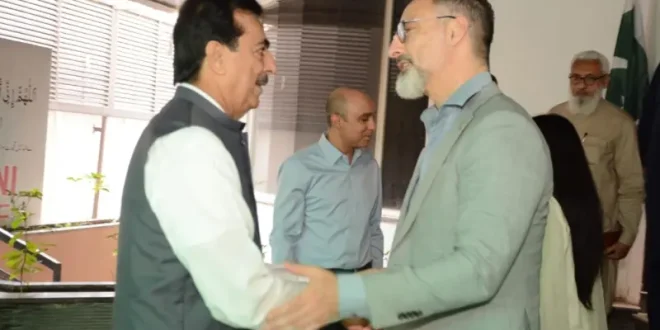
In a recent high-level meeting, Pakistan’s Senate Chairman Yousaf Raza Gilani conveyed profound concerns to United States Consul General Stetson Sanders regarding India’s approach to the critical Indus Waters Treaty (IWT). This diplomatic exchange, held in Lahore, underscored not only Pakistan’s anxieties over water security but also highlighted the intricate web of regional peace, economic cooperation, and the enduring significance of Pakistan-US bilateral relations.
What Happened: Pakistan Flags India’s “Coercive” Water Tactics
Senate Chairman Yousaf Raza Gilani specifically brought to the attention of US Consul General Stetson Sanders his apprehension over what he termed India’s “unilateral actions” concerning the Indus Waters Treaty. Gilani explicitly warned that using water as a “tool of coercion” carries grave consequences, threatening the stability of the entire region and potentially jeopardizing the livelihoods and food security of millions in Pakistan. This direct appeal to a US representative signals Pakistan’s call for international intervention and support to uphold treaty obligations and principles of international law. The backdrop to this concern is India’s decision in April 2025 to suspend the IWT, following the tragic Pahalgam terror attack, which was subsequently accompanied by increased dam construction and tighter regulation of existing facilities like the Baglihar Dam, directly impacting Pakistan’s vital water supplies.
Background: The Indus Waters Treaty and a History of Tensions
The Indus Waters Treaty, brokered by the World Bank in 1960, stands as one of the most successful water-sharing agreements globally. It allocated the waters of the eastern rivers (Ravi, Beas, and Sutlej) to India and the western rivers (Indus, Jhelum, and Chenab) to Pakistan. For decades, it served as a critical mechanism for managing water resources between two often-antagonistic nuclear-armed neighbors, facilitating peace despite numerous political and military flare-ups. However, the delicate balance of the IWT has faced increasing strain. India’s unilateral suspension in April 2025, in the wake of the Pahalgam terror attack, marked a significant departure from this long-standing accord. This action, coupled with enhanced construction and regulation of upstream dams, is perceived by Pakistan as a direct challenge to its water security, especially given its largely arid landscape and heavy reliance on the Indus basin for agriculture and sustenance. The US, having historically played a role in regional stability and counter-terrorism efforts, remains a crucial partner for both nations, often navigating a complex diplomatic tightrope.
Why It Matters: Water Security, Regional Peace, and International Law
The integrity of the Indus Waters Treaty is far more than a technical hydrological issue; it is a linchpin for regional stability. Its erosion threatens to exacerbate existing tensions between India and Pakistan, potentially escalating disputes beyond diplomatic channels. For Pakistan, water security is an existential concern. The nation is already water-stressed, and any significant reduction or irregular flow from the Indus system could cripple its agricultural sector, which forms the backbone of its economy and feeds a massive population. This directly impacts food security and could lead to widespread displacement and humanitarian challenges. Gilani’s emphasis on upholding international law underlines the broader principle that treaty obligations, even amidst political friction, must be respected to maintain a rules-based international order. The US engagement in this dialogue is critical, as it underscores the international community’s interest in preventing a potential water crisis from destabilizing a strategically vital region.
Impact on Pakistan: A Threat to Livelihoods and Economic Stability
The implications for Pakistan stemming from India’s altered stance on the IWT are profound. Pakistan’s economy is heavily agrarian, with the Indus river system serving as its lifeblood. Reduced water flows from upstream sources, especially at critical irrigation times, would devastate crop yields, impacting millions of farmers and agricultural laborers. This could trigger a cascade of economic consequences, including inflation, unemployment, and increased poverty. Furthermore, diminished water availability could exacerbate existing environmental challenges and spark internal water-sharing disputes within Pakistan. The concern voiced by Gilani is not merely hypothetical; it addresses a direct threat to the country’s socio-economic fabric and national security. Pakistan’s appeal to the US and the international community highlights its perception of this as a humanitarian and security crisis requiring urgent diplomatic intervention to restore adherence to the treaty.
Analysis: Navigating a Complex Diplomatic Landscape
The meeting between Senate Chairman Gilani and US Consul General Sanders offers a multifaceted snapshot of contemporary regional diplomacy. Pakistan’s decision to specifically raise the IWT issue with the US highlights its belief in Washington’s capacity to influence regional dynamics, either through direct mediation or by leveraging its diplomatic weight. The US, under President Trump’s administration, has shown a willingness to engage in sensitive regional issues, as evidenced by its facilitation of the Islamabad Talks between the US and Iran and its role in fostering a ceasefire between Pakistan and India during the April-May 2025 military standoff. This suggests a perceived continuity in US interest in maintaining regional equilibrium.
Beyond the immediate IWT concerns, the meeting served as a platform for Pakistan to reaffirm its commitment to a robust, forward-looking relationship with the US. Gilani’s emphasis on expanding cooperation in trade, investment, IT, energy, and agriculture underscores Pakistan’s strategic imperative to diversify its partnerships and attract foreign investment, particularly from its largest export destination, the US. The appreciation for US confidence in Pakistan’s role in regional peace, along with the successful conclusion of the US-Pakistan Agreement on Reciprocal Trade, indicates a concerted effort to project Pakistan as a responsible stakeholder and a stable economic partner.
In conclusion, Gilani’s outspoken concern over India’s IWT actions is a clear signal that Pakistan views water security as non-negotiable and calls for adherence to international agreements. This issue, intertwined with broader discussions on trade, regional peace, and parliamentary diplomacy, places the US in a critical position. Washington must carefully balance its strategic relationships with both India and Pakistan while upholding principles of international law and supporting mechanisms that prevent resource disputes from escalating into larger regional conflicts. The long-term stability of South Asia hinges not only on political goodwill but also on the effective and equitable management of shared vital resources like water, making the future of the Indus Waters Treaty a litmus test for regional peace.