Dost Pakistan Journeys Tours and safaris in the North & South Pakistsn
Related Articles


“`html
Imran Khan’s Hospital Shift: A Litmus Test for Pakistan’s Justice and Political Stability
The recent transfer of Pakistan Tehreek-e-Insaf (PTI) founder and former Prime Minister, Imran Khan, from Rawalpindi’s Adiala Jail to Shifa International Hospital in Islamabad under stringent security measures marks a significant development in Pakistan’s tumultuous political landscape. This move, mandated by a Supreme Court order, highlights the profound interplay between judicial authority, political maneuvering, human rights concerns, and the simmering tensions that define the nation’s current climate.
The News: A Court-Ordered Relocation Under Siege
In compliance with a Supreme Court directive, Imran Khan was shifted to Shifa International Hospital in the early hours of Friday. The operation was executed with extraordinary security, involving over 800 personnel from various law enforcement agencies. This robust deployment, which included setting up pickets and traffic management protocols, underscored the high-stakes nature of the former premier’s transfer and the authorities’ determination to prevent any potential disruptions.
Khan, who has been incarcerated since August 2023, is serving sentences in two prominent cases: the Toshakhana reference, concerning allegations of concealing details of state gifts, and the Al-Qadir Trust corruption case, which resulted in a 14-year sentence. Throughout his detention, concerns about his deteriorating health have been consistently voiced by his political party and family members. These concerns finally culminated in the Supreme Court’s intervention, which emphasized the state’s constitutional obligation to ensure humane treatment and necessary medical care for prisoners.
During the court proceedings, members of Khan’s family, including his sisters, were present, with one sister, Noreen Niazi, reportedly granted a rare meeting with him in jail to discuss his health and the court’s order. Meanwhile, PTI’s Information Secretary, Sheikh Waqas Akram, appealed to supporters via social media platform X (formerly Twitter) to maintain distance from the hospital, recognizing the strong sentiments of Khan’s followers but prioritizing his treatment and security.

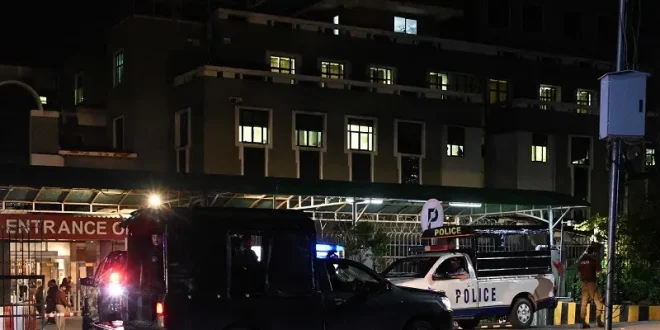
A police car is parked behind a barricade near Islamabad’s Shifa International Hospital on August 20, 2026. — Photo via Mohammad Asim

Police barricades are erected near Islamabad’s Shifa International Hospital on August 20, 2026. — Photo via Mohammad Asim
Background: The Political Quagmire Surrounding Imran Khan
Imran Khan’s journey from a celebrated international cricketer to the Prime Minister of Pakistan and then to an incarcerated political figure has been nothing short of dramatic. His ouster through a no-confidence vote in April 2022 triggered an unprecedented political crisis, marked by mass protests, allegations of foreign conspiracy, and a relentless crackdown on his party, the PTI.
The numerous legal cases against Khan, including the high-profile Toshakhana and Al-Qadir Trust cases, are viewed by his vast support base as politically motivated attempts to remove him from the political arena, particularly in the lead-up to and aftermath of the recent general elections. These cases have deepened the political polarization in Pakistan, with the government and opposition locked in a bitter “blame game” over the treatment of Khan and access to his personal physicians.
Pakistan’s Supreme Court often serves as a critical institution in mediating political disputes and safeguarding constitutional rights. Its directive for Khan’s hospital transfer is a clear assertion of judicial independence and a commitment to human rights, emphasizing that even high-profile political prisoners are entitled to proper medical care. This stance comes at a time when Pakistan is struggling with economic instability, governance challenges, and a highly fractured political landscape, making the judiciary’s role even more crucial.
Impact on Pakistan: Navigating the Intersection of Law and Politics
The transfer of Imran Khan to a hospital, though seemingly a medical procedure, carries significant weight for Pakistan’s volatile political climate:
- Reinforcing Judicial Authority: The Supreme Court’s firm order, despite a subsequent review petition filed by the government calling it “discriminatory” and “in excess of jurisdiction,” reinforces the judiciary’s role as a protector of fundamental rights. This decision can bolster public confidence in the judicial system’s ability to act as a check on executive power, even in politically charged circumstances.
- PTI’s Narrative and Public Mobilization: For Imran Khan’s supporters, this move, forced by the judiciary, validates their claims of his mistreatment and incarceration on questionable grounds. It could reignite their fervor, providing fresh impetus for their political narrative and potentially mobilizing the party’s base. The PTI’s call for supporters to maintain distance from the hospital highlights the party’s strategic awareness of public sentiment and the need to manage potential demonstrations responsibly.
- Government Under Scrutiny: The government faces ongoing scrutiny regarding its handling of political opponents and its adherence to human rights. While compliance with the SC order demonstrates respect for legal institutions, the initial resistance and the subsequent review petition underscore the deep political chasm. How the government manages Khan’s continued stay and eventual return to jail will significantly impact its public image and the perception of justice in Pakistan.
- Security and Stability Concerns: The elaborate security measures indicate the high level of concern about public reaction. Given Imran Khan’s massive following, particularly after events like the May 9th incidents, authorities are keenly aware of the potential for public unrest. Maintaining peace and order during and after his hospital stay is crucial for national security and overall political stability.
Analysis: A Delicate Balance of Power and Principle
Imran Khan’s court-ordered hospital transfer is a powerful symbol of the ongoing struggle for accountability, justice, and political space in Pakistan. It vividly illustrates the delicate balance of power between the executive, legislative, and judicial branches, and the constant pressure exerted by a highly politicized environment.
The Supreme Court’s assertion that “A prisoner does not, by reason of his incarceration, cease to be entitled to humane treatment and necessary medical care” is a fundamental principle that resonates far beyond this specific case. It serves as a crucial reminder to the state of its non-negotiable obligation towards all individuals in its custody, irrespective of their political standing. This judicial intervention sends a strong message that constitutional rights cannot be curtailed for political expediency.
The government’s immediate filing of a review petition against the SC order, categorizing it as “discriminatory” and “in excess of jurisdiction,” reveals the deep-seated resistance to judicial directives that might challenge executive actions or perceived political strategies. This friction between the judiciary and the executive is not new in Pakistan’s history but underscores the fragile nature of its institutional framework and the constant quest for supremacy.
For Imran Khan and the PTI, his health has become a potent political rallying point. Each concern, each restricted meeting, fuels the narrative of a leader bravely enduring persecution, thereby consolidating his support base. The hospital stay offers a temporary reprieve and greater transparency regarding his medical condition, potentially alleviating some family concerns about “mental torture.” However, the prospect of declaring a hospital room a “sub-jail” illustrates the state’s intent to maintain strict control over his incarceration, even during medical treatment.
In conclusion, this event is more than just a medical transfer; it’s a critical moment for Pakistan’s political future. It challenges the government to uphold human rights while managing a volatile political situation, tests the judiciary’s resolve in protecting fundamental liberties, and galvanizes a significant portion of the electorate around a deeply symbolic figure. The world watches keenly to see if Pakistan can navigate these complex currents towards a more stable and just future.
“`