Dost Pakistan Journeys Tours and safaris in the North & South Pakistsn
Related Articles


A Year On: Trump’s Gaza Peace Plan Crumbles Amidst Renewed Conflict and Occupation
A year has passed since a glimmer of hope emerged from the devastation of Gaza. On October 10, 2025, a ceasefire agreement, born from United States President Donald Trump’s ambitious ‘Comprehensive Plan to End Gaza Conflict,’ saw Israeli troops pull back from parts of the besieged territory. Touted by Trump as a blueprint for “eternal peace,” this diplomatic breakthrough aimed to halt a brutal two-year bombing campaign that had claimed over 74,000 Palestinian lives and laid much of Gaza to waste. The initial phase successfully secured the release of remaining hostages captured in Hamas’s October 7, 2023, attack, alongside hundreds of Palestinian prisoners held by Israel. Yet, as the calendar turns, the promise of peace remains largely unfulfilled, replaced by an unsettling expansion of Israeli occupation and a humanitarian crisis that deepens with each passing day. Far from achieving its goals, the plan appears not just stalled, but actively undermined by Israel, Washington’s key ally, amidst a volatile regional landscape.
Background: The High Stakes and the Fading Vision
The ‘Comprehensive Plan to End Gaza Conflict’ emerged from a period of extreme violence following the October 7, 2023, attacks. Israel’s subsequent military response led to a widespread international outcry, with organizations like Amnesty International and Human Rights Watch declaring its actions in Gaza as a “genocide.” The plan was therefore seen as a desperate attempt to de-escalate, offering a multi-phased approach to resolve the protracted conflict. Phase one was critical: a complete cessation of military operations, withdrawal of Israeli forces from designated areas, a comprehensive prisoner exchange, and an immediate surge in humanitarian aid.
While the prisoner exchange provided a brief moment of relief, the subsequent phases, including the demilitarization of Hamas, establishment of interim Palestinian governance by a ‘National Committee for the Administration of Gaza’ (NCAG), and the deployment of an ‘International Stabilisation Force’ (ISF), have either faltered or remained entirely unimplemented. This ambitious roadmap, intended to lead to reconstruction and eventually a “political horizon” for Palestinian self-determination, now serves as a stark reminder of the complexities and inherent power imbalances of the Israeli-Palestinian conflict.
The Perpetuation of Gaza’s Humanitarian Catastrophe
The peace plan explicitly called for the unobstructed entry of “full aid” into Gaza, envisioning levels no less than those seen in January 2025. This was a critical provision, given that Israeli policies had previously led to widespread famine. Yet, the reality is grim. International aid organizations continue to face significant hurdles, with staff and supplies routinely rejected or delayed by Israeli authorities, especially in the newly expanded “orange line” zones. The requirement for meticulous coordination with the Israeli military stifles the humanitarian effort.
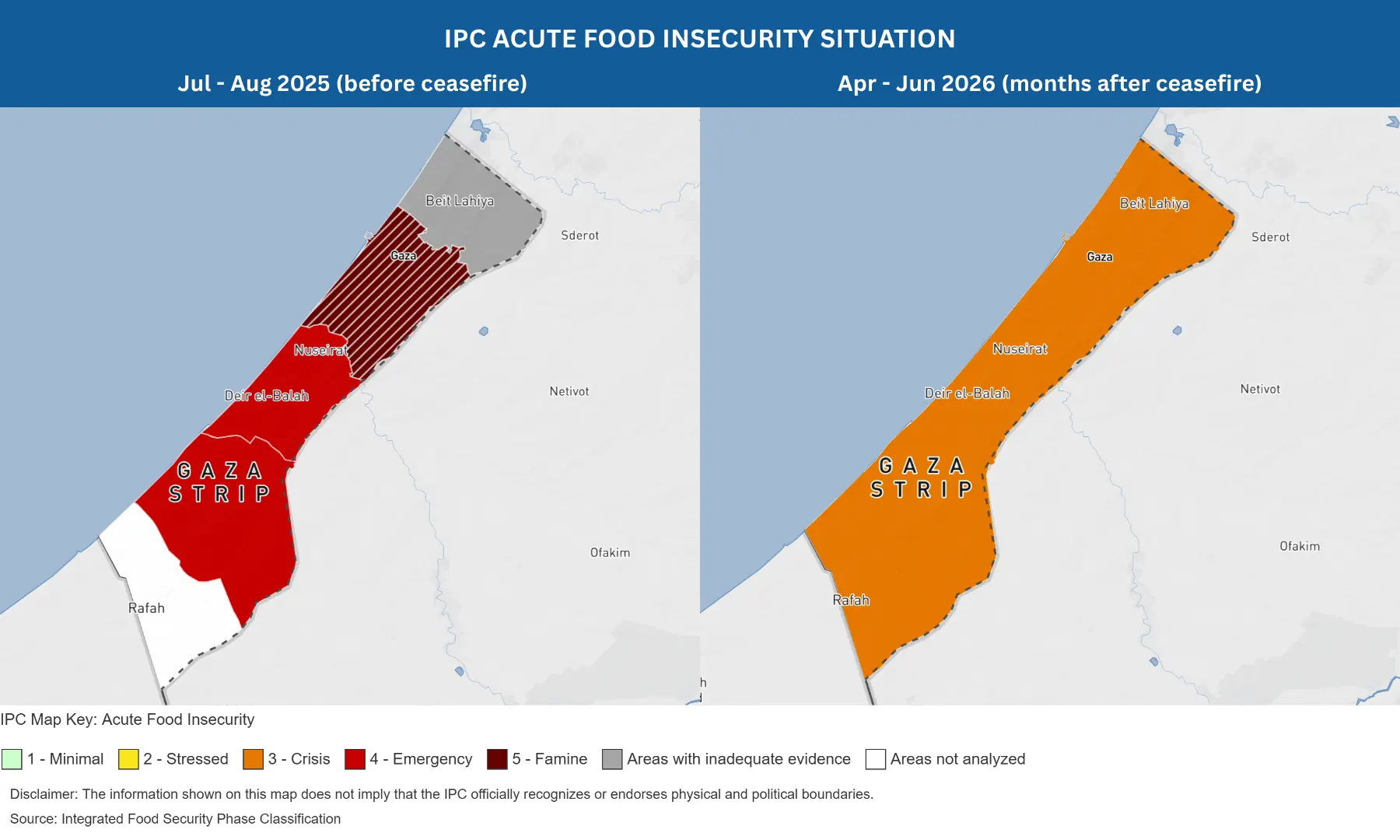
Consequently, food security remains a severe concern. The global hunger watchdog IPC has noted a slight improvement from emergency to crisis levels in some areas, but all five governorates of Gaza are still classified in IPC Phase 3 (Crisis), with over 212,000 people enduring Phase 4 (Emergency). Over 1.4 million people, 67% of the population, are projected to face high levels of acute food insecurity through December 2026. The number of aid trucks entering Gaza daily averages a mere 227, a far cry from the 600 mandated by the peace plan and desperately needed. Vital medical supplies, including prosthetics for the estimated 5,000 amputees from the conflict, are frequently denied, with Israel citing concerns they could be diverted to Hamas.
Stalled Demilitarization and Unseen Governance
A key component of the plan’s later phases involved the demilitarization of Hamas and the establishment of an interim technocratic Palestinian government under the supervision of the Trump-led ‘Board of Peace’. While Hamas reportedly agreed in July 2026 to transfer its weapons to this new government, a fundamental disagreement over sequencing has brought these efforts to a standstill. Israel insists on complete disarmament of Hamas before any further withdrawal of its forces, while Hamas demands that Israel first adhere to the ceasefire and the spirit of the peace plan. Despite mediation efforts by figures like Jared Kushner, no breakthrough has been achieved.
The ‘International Stabilisation Force’ (ISF), meant to secure borders and train Palestinian police, remains largely theoretical. Although a commander has been appointed and several nations, including Indonesia, Morocco, and Kazakhstan, have pledged personnel, the force has yet to be assembled. Concerns over the ISF’s legitimacy and a clear mandate, coupled with Israel’s requirement for individual approval of each contingent, have hampered its formation. Similarly, the US-backed ‘National Committee for the Administration of Gaza’ (NCAG), tasked with interim governance, has yet to enter the enclave, leaving a dangerous power vacuum.
Reconstruction: A Distant Echo of a Promise
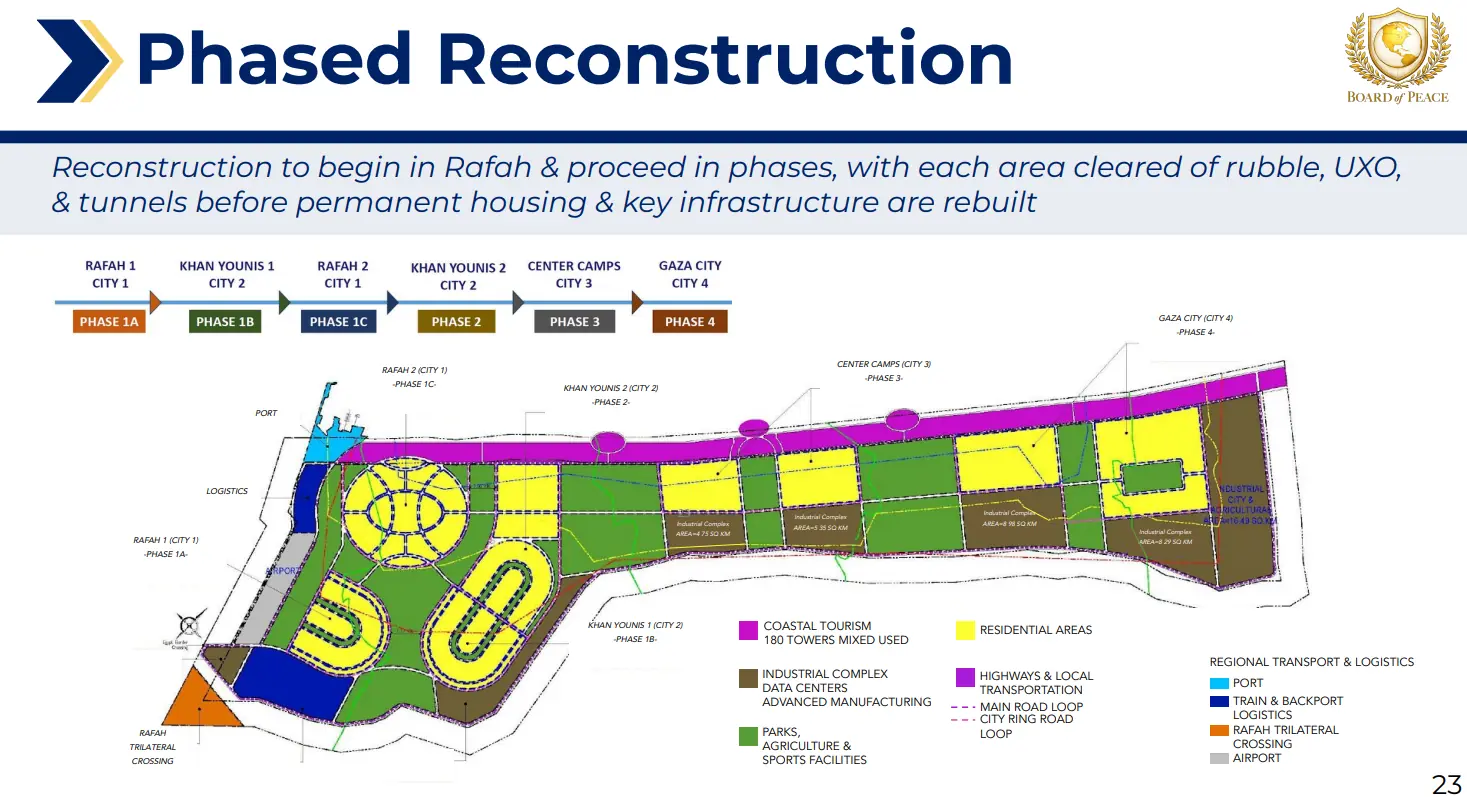
The vision of a rebuilt Gaza “for the benefit of the people” feels like a cruel mockery to its inhabitants. The UN estimates that Gaza requires a staggering $71.4 billion over the next decade for recovery and reconstruction, with $26.3 billion alone needed for essential services. In stark contrast, the ‘Board of Peace’ proposed a mere $2.45 billion recovery plan spanning six months – a fraction of what is truly required. The two-year conflict has effectively set Gaza back 77 years, contracting its economy by an estimated 84%. Over half of its hospitals are non-functional, schools are largely destroyed, and hundreds of thousands of housing units lie in ruins. A shocking 60% of Gaza’s population has been displaced, many now living in damaged buildings at risk of collapse, a reality tragically highlighted by a recent incident where 20 people died after an apartment building collapsed from prior Israeli strike damage.
Impact on Pakistan and the Regional Quagmire
Pakistan, a long-standing advocate for Palestinian rights, has had a nuanced engagement with Trump’s peace plan. Initially, Deputy Prime Minister Ishaq Dar expressed reservations, distancing Pakistan from a version of the roadmap that had reportedly been altered by Netanyahu’s intervention, making it less favorable to Palestinians than previously agreed with Muslim nations. However, Pakistan later signaled its readiness to contribute troops to the ISF, but with a crucial caveat: its role would be limited to peacekeeping and humanitarian assistance, emphatically not disarming Palestinian resistance groups like Hamas. This position underscores Pakistan’s commitment to Palestinian self-determination while navigating the complexities of international peacekeeping mandates. The country, alongside a bloc of Muslim nations including Egypt, Turkiye, Saudi Arabia, and others, has consistently called on Israel to uphold its commitments under the UNSC-endorsed plan, particularly regarding humanitarian aid and infrastructure rehabilitation.
Regionally, the context has also shifted. Donald Trump, who initially presented himself as a “peacemaker,” has since pivoted to a more aggressive posture, launching a military campaign alongside Israel against Iran. This shift, coupled with the Muslim bloc’s attention being increasingly diverted to “other Middle East conflicts,” risks diluting the international pressure on Israel regarding Gaza. Domestically, with Israeli general elections approaching on October 27, Prime Minister Netanyahu faces internal criticism over the 2023 Hamas attacks, which may fuel hardline stances. Calls from far-right Israeli ministers for the annexation of parts of Gaza and the “voluntary emigration” (effectively expulsion) of Palestinians highlight the grave threats to the territory’s future and directly contradict the tenets of the very peace plan Trump championed.
Analysis: A Plan Undermined by Reality and Unresolved Power Dynamics
The failure of Trump’s Gaza peace plan is not merely a matter of delayed implementation but a profound testament to fundamental flaws and unresolved power dynamics. Firstly, the plan, despite its grand title, arguably never truly sought to address the root causes of the Israeli-Palestinian conflict – namely, the ongoing occupation, blockade, and denial of Palestinian rights. Instead, it appeared to prioritize a security-centric approach for Israel and manage the symptoms rather than cure the ailment.
Secondly, the plan lacked any effective enforcement mechanism. With the United States acting as the primary mediator and also Israel’s staunchest ally, there was an inherent imbalance in its ability to compel Israeli compliance. Israel’s continued expansion of control, disregard for ceasefire provisions, and obstruction of humanitarian aid demonstrate a clear lack of accountability and a perceived impunity, emboldened by its patron’s steadfast support. The assurance given by the Board of Peace to Netanyahu, prioritizing Hamas’s full demilitarization before Israeli withdrawal, further illustrates the bias embedded in the mediation.
Thirdly, the conflicting objectives of the parties proved insurmountable. Israel’s unwavering focus on security and control clashes directly with the Palestinian aspiration for self-determination and an end to occupation. Hamas’s demand for Israeli ceasefire compliance before disarmament is a rational response to a year of persistent attacks and territorial expansion. The proposed “eternal peace” thus became a mirage, shattered by daily realities on the ground.
Looking ahead, the future for Gaza appears bleak. The humanitarian crisis will only deepen, exacerbating suffering for a population already living in unimaginable conditions. The absence of a functioning governance body (NCAG) and a stabilizing force (ISF) creates a vacuum prone to further instability and potential radicalization. The calls for annexation and expulsion by Israeli politicians pose an existential threat to Palestinian presence in Gaza, highlighting the growing chasm between international law and the actions of an occupying power.
The crumbling of Trump’s ‘Comprehensive Plan’ underscores the urgent need for a truly impartial and robust international effort, one that prioritizes accountability, human rights, and a just resolution based on international law. Without genuine political will to enforce agreements and address the root causes of the conflict, the cycle of violence and suffering in Gaza will tragically continue, with the promise of peace remaining a distant, unattainable dream.
Additional input from Reuters

Header image: Made with pictures of an Israeli tank on Israeli side of the Gaza border on Aug 20, 2025, Board of Peace meeting on Feb 19, 2026 and a map of Gaza. — via Reuters