 Dost Pakistan Journeys Tours and safaris in the North & South Pakistsn
“`html
‘Big, Bold and Important First Step’: Unpacking the Pakistan-Saudi-Turkiye Defence Pact
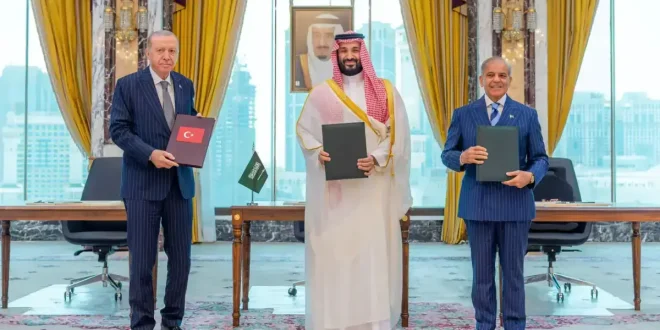
A new trilateral defence agreement forged between Pakistan, Saudi Arabia, and Turkiye is sending ripples across the geopolitical landscape, drawing notable praise from former US President Donald Trump. Termed the Makkah Joint Defence Agreement, this pact, signed on August 7, 2024, signals a potentially significant shift in regional security dynamics.
The News
The signing of the Makkah Joint Defence Agreement by Pakistan, Saudi Arabia, and Turkiye has been met with a fervent endorsement from former US President Donald Trump. Taking to his Truth Social platform, Trump hailed the pact as a “BIG, BOLD, IMPORTANT FIRST STEP,” expressing his pleasure at seeing these nations “finally” sign the agreement. He framed it as an indication of the Middle East “coming together” and countries gaining a more “meaningful” capacity for self-defence.
In response, Pakistan’s Prime Minister Shehbaz Sharif conveyed his “deep appreciation” for Trump’s supportive remarks, affirming Pakistan’s commitment to collaborate with Saudi Arabia and Turkiye in safeguarding their own nations and the broader region. Sharif also used the opportunity to commend Trump for his “courageous and decisive leadership” during a brief military conflict with India last year, crediting him with averting a “nuclear catastrophe” in South Asia. The core tenet of the new agreement is to strengthen collective deterrence, essentially stipulating that an attack against one signatory will be considered an attack against all, laying the groundwork for deeper political and military mechanisms, including defence industry cooperation.
Background
The Makkah Joint Defence Agreement emerges from a complex and often volatile regional environment. For years, the Middle East and surrounding Islamic world have grappled with persistent security challenges, from internal strife to proxy conflicts and the lingering shadow of the US-Iran war, which has contributed to instability and attacks, notably by Houthi rebels. In this context, nations are increasingly seeking to bolster their own defence capabilities and diversify their strategic partnerships.
Saudi Arabia, a key economic and religious power, faces direct threats from Houthi missile and drone attacks and seeks to reinforce its security architecture. Its pivot towards new defence alliances reflects a desire for greater autonomy and a hedge against perceived shifts in major power commitments. Turkiye, under President Erdogan, has been pursuing an increasingly assertive and independent foreign policy, aiming to establish itself as a prominent regional leader. This includes expanding its defence industry and forging strategic ties that align with its broader pan-Islamic or pan-Turkic aspirations.
Pakistan, a nuclear-armed state with a strategically vital location, has long maintained strong historical and military ties with Saudi Arabia, often receiving economic support. Its relationship with Turkiye has also deepened significantly in recent years, particularly in defence industrial collaboration and cultural exchange. This pact can be seen as a natural evolution of these bilateral relationships into a more formalized, multilateral security framework.
The timing of Trump’s endorsement is also noteworthy. As a former president, his comments, though not official US policy, carry significant weight, especially among his political base. His “America First” philosophy often encouraged allies to take greater responsibility for their own defence, a sentiment that aligns with the spirit of this new pact.
Impact on Pakistan
For Pakistan, joining the Makkah Joint Defence Agreement carries multifaceted strategic and diplomatic implications:
- Enhanced Strategic Depth and Security: The agreement provides Pakistan with a formal collective security guarantee from two significant Muslim nations. This could act as a deterrent against potential aggressors, as highlighted by Prime Minister Shehbaz Sharif’s reference to the previous year’s military standoff with India. It strengthens Pakistan’s position in a volatile region by diversifying its security alliances beyond its traditional reliance on China and, historically, the US.
- Economic and Defence Industry Collaboration: Turkiye’s defence ministry explicitly mentioned deepening defence industry cooperation under the pact. Pakistan possesses a growing defence production base and stands to benefit from Saudi investment and Turkish technological expertise. This could lead to joint ventures, technology transfer, and increased arms trade, boosting Pakistan’s defence capabilities and economy.
- Increased Diplomatic Leverage: The alliance elevates Pakistan’s standing within the Muslim world and on the global stage. It positions Pakistan as a pivotal player in a new and significant regional grouping, potentially enhancing its diplomatic influence and bargaining power in international forums.
- Regional Balancing Act: While beneficial, Pakistan will need to carefully navigate its relationships with other regional powers, particularly Iran. The pact’s stated defensive nature is crucial here, as Foreign Minister Ishaq Dar emphasized it is “open to any country in the region” willing to uphold its principles, potentially mitigating immediate concerns of exclusion.
Analysis
The Makkah Joint Defence Agreement represents more than just a symbolic handshake; it’s a profound declaration of collective security with potentially far-reaching geopolitical implications. Its core principle—treating an attack on one as an attack on all—echoes the mutual defence clauses of alliances like NATO, signaling a serious commitment to shared defence and deterrence among the three signatories.
This pact can be interpreted as a strategic response by Saudi Arabia, Turkiye, and Pakistan to a changing global order where traditional great power guarantees may be perceived as less absolute. For Saudi Arabia, it offers a diversified security umbrella against regional threats, aligning with its Vision 2030 goals of greater self-reliance. For Turkiye, it solidifies its ambition to lead within the Muslim world and project its influence, as evidenced by President Erdogan’s hope for its expansion to include “all countries of the region.” Pakistan gains critical strategic depth and economic opportunities, particularly in defence manufacturing, while bolstering its regional standing.
The endorsement from Donald Trump is significant. While he is no longer in office, his voice resonates with a considerable portion of the US political spectrum. His approval signals a potential US willingness, at least from this influential segment, to see regional partners take more initiative in their own defence, aligning with a “burden-sharing” narrative. This could also be seen as an attempt to project strength and stability in the Middle East through regional partnerships, possibly as a counterweight to Iranian influence, despite Iran’s surprisingly positive initial comments on the pact.
The aspiration for the pact’s expansion, particularly the mention of Egypt, highlights a broader vision of a more unified Muslim defence bloc. However, integrating more nations will present challenges, including reconciling diverse national interests, navigating existing rivalries, and establishing effective command and control structures. How this pact interacts with existing regional frameworks, such as the Organization of Islamic Cooperation (OIC) or even the Gulf Cooperation Council (GCC), will be crucial to its long-term success and impact.
Ultimately, the Makkah Joint Defence Agreement is a testament to evolving geopolitical currents. It signifies a move by key Islamic nations to forge their own security destiny, leveraging their collective strengths. While its full operationalization and regional impact will unfold over time, it unequivocally marks a “BIG, BOLD, IMPORTANT FIRST STEP” towards a potentially recalibrated security architecture in the Islamic world and beyond.
“`
