Dost Pakistan Journeys Tours and safaris in the North & South Pakistsn
Related Articles
EU-Pakistan Strategic Dialogue: Elevating Ties Amidst Geopolitical Shifts
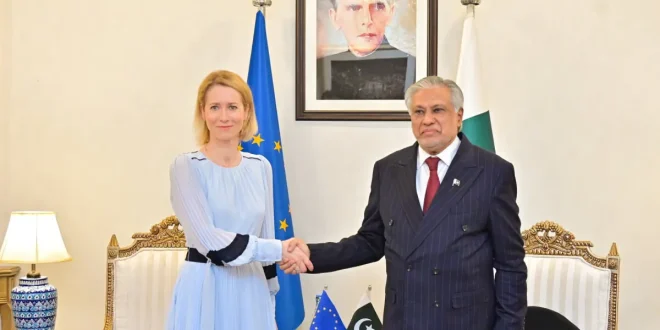
The recent visit of Kaja Kallas, the European Union’s High Representative for Foreign Affairs and Security Policy, to Islamabad for the 8th EU-Pakistan Strategic Dialogue, marks a significant moment in the evolving relationship between the two entities. Her characterization of Pakistan as a “major regional power” and an “important partner” underscores a renewed recognition of Pakistan’s strategic relevance in a volatile global landscape.
What Happened: Reaffirming a Multidimensional Partnership
The high-level dialogue, co-chaired by Kallas and Pakistan’s Deputy Prime Minister and Foreign Minister Ishaq Dar, saw a robust discussion on a wide array of bilateral and regional issues. Kallas’s visit, following a notably shorter gap since the last strategic dialogue compared to previous years, signals an intensified engagement. Key takeaways included the reaffirmation of the EU as Pakistan’s largest export destination, the critical role of the Generalised Scheme of Preferences Plus (GSP+) in this trade, and an appreciation for Pakistan’s diplomatic efforts in de-escalating tensions between the US and Iran.
Beyond economics and regional security, discussions encompassed climate resilience, digital infrastructure, clean energy, migration, and people-to-people connections, exemplified by Pakistan’s consistent top ranking in Erasmus Mundus scholarships. Concurrently, Kallas reiterated the EU’s firm stance on GSP+ conditionalities, emphasizing progress on good governance, environmental protection, and particularly, labor and human rights.
Background: A Relationship Rooted in Trade and Strategic Interests
The relationship between the European Union and Pakistan is multifaceted, built on decades of cooperation agreements, including the Strategic Engagement Plan (SEP) 2019 and the Cooperation Agreement 2004. Economically, the EU stands as Pakistan’s most crucial trading partner, absorbing a larger share of its exports than the US and China combined. This significant trade volume, currently at €12 billion, is substantially boosted by Pakistan’s beneficiary status under the EU’s GSP+ scheme.
Introduced in 2014 and recently extended until 2027, GSP+ grants developing nations preferential access to the EU market by significantly reducing or eliminating tariffs on key exports. However, this preferential access is explicitly tied to the beneficiary country’s commitment and demonstrated progress in implementing 27 international conventions related to human rights, labor rights, environmental protection, and good governance. This framework allows the EU to promote its core values while fostering economic development in partner countries.
Geopolitically, Pakistan’s location at the crossroads of South Asia, Central Asia, and the Middle East, coupled with its large population and nuclear capability, has long positioned it as a significant regional player. Its historical involvement in regional dynamics, from Afghanistan to the broader Islamic world, underscores its strategic importance to global powers like the EU, particularly in managing complex international crises.
Why It Matters: Signalling Strategic Alignment Amidst Global Instability
Kallas’s visit and the candid nature of the discussions hold considerable significance for both parties. For the EU, it represents a strategic engagement with a key partner in a region grappling with profound geopolitical shifts. Recognizing Pakistan as a “major regional power” is not mere diplomatic courtesy; it’s an acknowledgment of its capacity to influence regional stability, particularly concerning Afghanistan and the Middle East, where Pakistan’s mediation between the US and Iran has earned high praise.
For Pakistan, the dialogue reaffirms its international standing and the indispensable nature of its economic ties with Europe. The EU’s appreciation for its diplomatic role provides valuable validation and potentially opens avenues for further collaborative peacemaking efforts. However, the explicit reiteration of GSP+ conditions also serves as a crucial reminder of the ongoing expectations regarding human rights and governance reforms, an area where Pakistan has faced scrutiny.
The expanded scope of cooperation, moving beyond traditional trade to include climate action, digital transformation, and clean energy, indicates a maturation of the partnership. It suggests a shared vision for addressing contemporary global challenges, positioning the EU and Pakistan as collaborators in building resilience and sustainable development in a complex world.
Impact on Pakistan: Economic Lifeline, Reform Imperative, and Diplomatic Leverage
The outcomes of the Strategic Dialogue have tangible impacts on Pakistan. Economically, the continued robust trade relationship under the GSP+ framework is a lifeline, particularly as Pakistan navigates significant economic challenges. Sustained access to the vast European market ensures export revenues, supports industries, and creates employment, contributing critically to the nation’s financial stability.
Diplomatically, the EU’s recognition of Pakistan’s role in US-Iran mediation elevates its international stature. This diplomatic capital can be leveraged in other regional contexts, potentially enhancing its influence and facilitating its stated goal of strengthening multilateralism. Pakistan’s proactive engagement on issues like Kashmir and the Indus Water Treaty during the dialogue also demonstrates its commitment to using such platforms to advance its core foreign policy objectives.
However, the GSP+ conditions present a significant domestic imperative for Pakistan. The EU’s consistent emphasis on progress in human rights, labor laws, and governance places direct pressure on the government to enact and demonstrate meaningful reforms. While challenging, fulfilling these obligations is not just about maintaining trade benefits; it aligns with broader goals of improving citizen well-being and strengthening democratic institutions.
Furthermore, cooperation in areas like climate resilience and digital infrastructure offers Pakistan vital opportunities for modernization and sustainable development, enabling it to better tackle pressing domestic issues and prepare for future challenges.
Analysis: Navigating a Complex, Conditional Path Forward
The 8th EU-Pakistan Strategic Dialogue underscores a pragmatic and evolving relationship, characterized by both strategic convergence and inherent conditionalities. The EU, a normative power, consistently seeks to integrate its values into its foreign policy, using tools like GSP+ to encourage human rights and good governance. This creates a delicate balancing act for Pakistan, which must navigate its economic dependence on the EU with its domestic political realities and sovereignty concerns.
Kallas’s explicit praise for Pakistan’s mediation efforts in the US-Iran conflict highlights a willingness within the EU to recognize and utilize Pakistan’s unique geopolitical influence, even while maintaining pressure on internal reforms. This nuanced approach suggests that the EU views Pakistan not merely as a trade partner, but as a crucial contributor to regional and global stability, especially in a “contested geopolitical environment” where “rules-based international order” is under strain.
Looking ahead, the relationship appears poised for deeper engagement, as indicated by the rapid succession of dialogues and the expressed desire for a “forward-looking framework” and higher-level visits. The diversification of cooperation into areas like digital, climate, and energy points towards a more comprehensive and strategic partnership, moving beyond a purely transactional dynamic. However, the durability and true potential of this partnership will hinge on Pakistan’s sustained commitment to the GSP+ conventions and the EU’s consistent, yet flexible, application of its diplomatic and economic instruments. This strategic dialogue is less an endpoint and more a reaffirmation of a complex, conditional, yet increasingly vital path forward for both the EU and Pakistan.