Dost Pakistan Journeys Tours and safaris in the North & South Pakistsn
Related Articles
“`html
MQM-P’s Violent Infighting: A Symptom of Karachi’s Deepening Political Fragmentation
Anatomy of a political implosion: The recent clash at MQM-P’s headquarters reveals deeper fissures within a once-dominant Karachi force, with far-reaching implications for urban stability and national politics.
The News: Chaos Erupts at Bahadurabad Headquarters
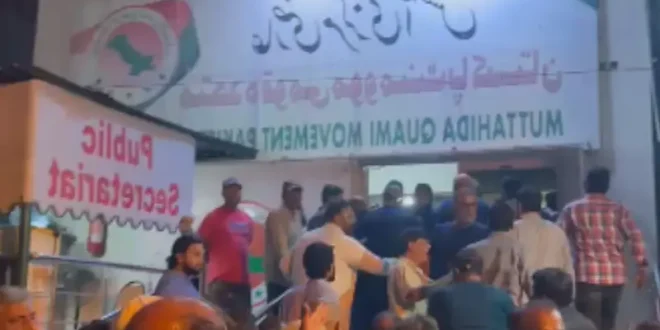
The Muttahida Qaumi Movement-Pakistan (MQM-P) witnessed a dramatic escalation of its internal rivalries on Sunday evening, as a meeting at its Bahadurabad headquarters in Karachi dissolved into violent chaos. The scuffle, which reportedly involved heavy firing, left at least four individuals injured. According to officials, the clash erupted between supporters of two distinct factions: one aligned with Anis Qaimkhani and Mustafa Kamal, and another backing Dr. Khalid Maqbool Siddiqui and Aminul Haque. The situation reportedly intensified after Dr. Siddiqui left the meeting, leading to allegations of physical assaults and forcible removals of workers. One person suffered a bullet wound, while three others sustained injuries from sticks and stones, necessitating hospitalisation.
Despite the considerable disturbance and the presence of police contingents on site, no immediate arrests were made, and no formal complaint was lodged with the authorities. Police maintained their presence until party leaders and workers dispersed late into the night. Sindh government spokesperson Sadia Javed swiftly weighed in on the incident via X, criticising MQM-P’s inability to maintain internal order while accusing the party of attempting to divide the province, emphatically stating that “Sindh will remain united.”
Background: A Legacy of Splits and Struggle for Identity
To fully grasp the significance of the recent violence within MQM-P, it’s essential to contextualize it within the tumultuous history of the Muttahida Qaumi Movement. Established in the mid-1980s as a political platform for the Mohajir (Urdu-speaking) community, MQM quickly ascended to become the undisputed dominant political force in Karachi and urban Sindh. Its journey, however, has been punctuated by periods of intense conflict, allegations of militancy, and recurrent internal fragmentation.
A pivotal moment arrived in 2016 when the party’s founder, Altaf Hussain, delivered a controversial anti-state speech, triggering a severe state crackdown and the effective disjunction of the party’s leadership in Pakistan from its London-based founder. This led to the emergence of MQM-Pakistan (MQM-P), led by Dr. Khalid Maqbool Siddiqui, which aimed to operate autonomously within Pakistan’s democratic framework. Yet, this transition has been anything but smooth. Prominent figures like Mustafa Kamal and Anis Qaimkhani, who had previously formed their own splinter group, the Pak Sarzameen Party (PSP), later engaged in various attempts to rejoin or merge with MQM-P. These convoluted realignments have been consistently plagued by deep-seated power struggles, divergent strategic visions, and personality clashes that have prevented any lasting party unity.
The Bahadurabad office itself holds symbolic importance, having served as a flashpoint in previous internal disputes. The latest clash is not an isolated incident but rather the clearest manifestation yet of long-standing rivalries and an ongoing existential crisis as MQM-P navigates its post-Altaf identity, grapples with a leadership vacuum, and struggles with its diminishing political footprint in its traditional stronghold.
Impact on Pakistan: Karachi’s Stability at Stake
The escalating internal strife within MQM-P extends far beyond the party’s immediate confines, carrying significant implications for Karachi, the province of Sindh, and indeed, Pakistan’s broader political stability.
- Heightened Political Instability in Karachi: As Pakistan’s economic powerhouse and largest metropolis, Karachi’s political tranquillity is fundamental to national economic health and social cohesion. MQM-P’s persistent internal conflicts fuel an environment of uncertainty and volatility, which can deter vital investment and exacerbate existing governance challenges in the city.
- Erosion of Public Trust and Representation: Such public and violent displays of disunity severely undermine public confidence in democratic institutions and political parties. For the Mohajir community, whom MQM-P historically represented, this fragmentation translates into an increasingly diluted and ineffective political voice, potentially fostering disillusionment and further marginalization.
- Opportunity for Rival Parties: The weakening of MQM-P inevitably creates a significant political vacuum in urban Sindh. Rival political entities, most notably the Pakistan Peoples Party (PPP), Pakistan Tehreek-e-Insaf (PTI), and Jamaat-e-Islami (JI), are poised to capitalize on this disarray. The critical remarks from the Sindh government spokesperson underscore the PPP’s strategic interest in further diminishing MQM-P’s influence, particularly with upcoming local government or general elections on the horizon.
- Law and Order Concerns: The reported use of firearms within a party office, a space designated for political discourse, raises serious questions about the breakdown of law and order and the state’s capacity to ensure safety within political activities. It sets a dangerous precedent, potentially normalising violence in political engagement.
Ultimately, the MQM-P’s internal implosion serves as a stark barometer for the overall political health of Karachi. A fractured and embattled MQM-P complicates efforts to address the city’s myriad and complex challenges, from critical infrastructure deficits to persistent security concerns, thereby impacting the entire nation’s well-being.
Analysis: A Party Adrift in a Shifting Political Landscape
The violent scuffle at Bahadurabad is far more than a mere internal squabble; it is a profound manifestation of MQM-P’s deep-seated existential crisis. The party, once a formidable and indispensable player in both federal and provincial politics, appears increasingly adrift, struggling desperately to redefine its identity and purpose in the complex post-Altaf Hussain era.
At its core, the persistent conflict between the Siddiqui and Kamal/Qaimkhani factions likely stems from a tangled web of factors: an intense power struggle for control over the party’s dwindling resources and remnants, fundamentally differing visions for its future strategic direction, and personal rivalries that have been allowed to fester over many years. Kamal and Qaimkhani often represent a faction that advocates for a more assertive, perhaps even confrontational, approach to politics, while Siddiqui’s group has frequently pursued a more conciliatory and pragmatic path within the mainstream political system. The absence of a unifying, charismatic figure or a clear, universally accepted ideological framework in the wake of Altaf Hussain’s departure has rendered the party exceptionally vulnerable to these powerful internal centrifugal forces.
The swift and pointed response from the Sindh government, articulated through Sadia Javed’s remarks, highlights a broader and strategically crafted political narrative: MQM-P’s demonstrable inability to maintain internal cohesion is being framed as a failure to unite its own community, conveniently juxtaposed against historical accusations of attempting to ‘divide Sindh’. This narrative is strategically designed to further undermine MQM-P’s credibility and deepen its isolation within the provincial political landscape, significantly benefiting the ruling PPP.
For Karachi, this ongoing political fragmentation is unequivocally detrimental. A strong, unified voice representing its diverse urban population is crucial for effective advocacy, equitable resource allocation, and sustainable development. Without such a voice, the city’s myriad and often acute issues risk being continuously sidelined in provincial and national discourse. The incident also tragically underscores a worrying trend of violence increasingly permeating political spaces, setting a dangerous precedent for Pakistan’s evolving democratic culture.
Looking ahead, MQM-P faces an exceptionally arduous uphill battle for survival and continued relevance. Unless its fragmented leadership can somehow bridge these deep internal divides, articulate a compelling and cohesive vision, and effectively re-engage its increasingly disillusioned voter base, the party risks becoming a historical footnote. Such an outcome would leave a significant and potentially volatile political vacuum in urban Sindh that other, perhaps more potent, political forces will inevitably seek to fill. The Bahadurabad clash serves as a grim and potent reminder that for MQM-P, the most formidable fight is no longer just against its traditional political rivals, but increasingly, against itself.
“`