 Dost Pakistan Journeys Tours and safaris in the North & South Pakistsn
Related Articles


In any democratic country, the constitution serves as the supreme national covenant. Ideally, the existence of a constitution should make any additional “Charter of Democracy” unnecessary. However, Pakistan’s political history has been marked by repeated constitutional disruptions, institutional conflicts, and deviations from democratic principles. As a result, discussions about a new democratic charter continue to emerge whenever political tensions intensify.
Prime Minister Shehbaz Sharif’s recent call for dialogue with the opposition and the proposal for a renewed “Charter of Democracy” may appear difficult to take seriously at first glance. The reason is simple: Pakistan’s political leadership has spent decades undermining the very constitutional framework that should have guaranteed democratic continuity. Nevertheless, any invitation to dialogue should be welcomed, provided it is accompanied by sincerity and practical measures.
A meaningful political agreement cannot be achieved without engaging all major political stakeholders. This includes discussions with Pakistan Tehreek-e-Insaf (PTI) founder and former Prime Minister Imran Khan. At the same time, opposition leaders must also demonstrate flexibility and a willingness to participate in constructive negotiations. Political reconciliation requires compromise from all sides.
Pakistan as a Mediator Abroad, But Divided at Home
Pakistan has recently received international recognition for its role as a mediator and facilitator of dialogue between rival parties. If Pakistan can contribute to peace agreements and conflict resolution between nations, it raises an important question: why can the country’s own political leadership not achieve a similar understanding among fellow citizens?
The government should take the initiative by creating an atmosphere conducive to dialogue. If opposition leaders seek access to imprisoned political figures, including meetings with Imran Khan, such requests should be facilitated within legal frameworks. Similarly, where possible, the release of political detainees can help reduce tensions. History shows that governments are strengthened, not weakened, by confidence-building measures.
The Decline of National Politics
One of Pakistan’s most significant political challenges is the gradual weakening of national political parties. The country’s major political forces increasingly appear confined to specific provinces rather than operating as genuinely national movements.
The Pakistan Muslim League (N) is often viewed as Punjab-centric, while the Pakistan Peoples Party’s strongest support remains concentrated in Sindh. PTI’s political influence is largely associated with Khyber Pakhtunkhwa, while nationalist parties dominate much of the political discourse in Balochistan.
This trend is not new. The ban on the National Awami Party (NAP) decades ago significantly altered Pakistan’s political landscape. The party never regained its national position, and many Baloch and Pashtun political leaders gradually moved away from mainstream national politics. Today, the Awami National Party is primarily viewed as a Pashtun political party, while several Baloch political organizations remain largely provincial in character.
If Pakistan’s political future becomes divided among provincial identities rather than national consensus, the country risks entering an even deeper political crisis. The inability to recognize this danger may itself be one of Pakistan’s greatest political failures.
From a Charter of Democracy to a Charter of Politics
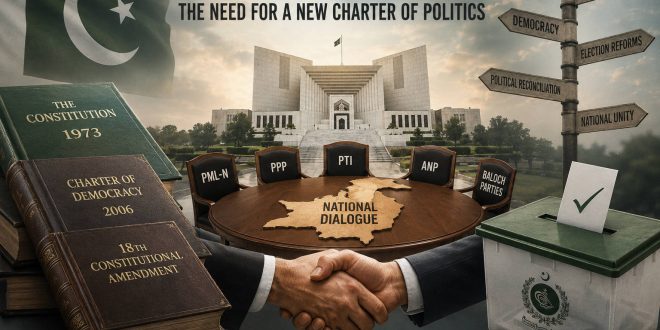
Before discussing a new Charter of Democracy, Pakistan may first need a broader “Charter of Politics.” Such a framework would focus on preserving national political space, protecting democratic competition, and ensuring that political disagreements are resolved through constitutional means rather than institutional interventions.
The current situations in Azad Kashmir and Balochistan illustrate the need for a comprehensive national political vision. While the issues facing these regions differ considerably, both require political solutions rather than administrative or coercive approaches.
History repeatedly demonstrates that restrictions, bans, and political exclusions rarely solve problems. More often, they deepen grievances and create new tensions.
The Central Issue: Electoral Credibility
Although Punjab and Sindh face different political realities, one common issue affects the entire country: the credibility of elections.
Many of Pakistan’s political crises originate from allegations of electoral manipulation, disputed mandates, and the failure to transfer power according to the will of voters. The country’s political history contains numerous examples where election results became the source of long-term instability.
If Pakistan seeks to restore confidence in national politics, political actors must agree upon certain fundamental democratic principles. This requires not only a formal political covenant but also the courage to accept electoral outcomes, even when they are politically inconvenient.
Three Historic Political Documents
Over the past fifty years, three major political documents have played a central role in shaping Pakistan’s democratic evolution:
- The Constitution of 1973
- The Charter of Democracy (2006)
- The 18th Constitutional Amendment
Among these, the 1973 Constitution and the 18th Amendment represent broad political consensus achieved through elected representatives from across the political spectrum. Any attempt to undermine or politicize these foundational documents risks creating further constitutional and political instability.
In principle, the Constitution itself should serve as the ultimate democratic charter. No political agreement can be superior to the Constitution. If Pakistan’s institutions and political actors genuinely respected the constitutional framework—not merely in rhetoric but in practice—many of the country’s recurring crises could be avoided.
Lessons from the Charter of Democracy
The Charter of Democracy signed in 2006 emerged during a period when constitutional governance had been interrupted and political leaders faced exclusion from the democratic process. Former Prime Ministers Nawaz Sharif and Benazir Bhutto acknowledged that political forces had often been used against one another, weakening democratic institutions in the process.
Following Benazir Bhutto’s tragic assassination, cooperation between the Pakistan Peoples Party and Pakistan Muslim League (N) initially produced encouraging results. Although the alliance did not endure indefinitely, it contributed to Pakistan’s first peaceful transfer of power between elected governments.
Yet, the opportunity to provide stronger constitutional protection to democratic principles was not fully realized. Had the Charter of Democracy been more deeply institutionalized, Pakistan’s political system might have evolved differently.
Repeating Historical Cycles
Many observers argue that the political treatment experienced by Nawaz Sharif and Benazir Bhutto in earlier decades bears similarities to the challenges currently faced by Imran Khan. Rather than celebrating the political difficulties of rivals, Pakistan’s leaders should learn from history.
When political figures are elevated or marginalized through non-political means, the long-term casualty is democratic politics itself. The result has been the gradual transformation of national political competition into fragmented provincial contests.
A Path Forward
If Pakistan wishes to emerge from its current national political crisis, all major political forces must eventually sit at the same table. The country’s future cannot be secured through exclusion.
The present dilemma is clear: many supporters of PTI argue that the electoral mandate belongs to Imran Khan, while governmental authority rests with Prime Minister Shehbaz Sharif and the ruling coalition. Bridging this divide requires political courage, constitutional commitment, and genuine dialogue.
A new democratic understanding may ultimately need to begin with the question of electoral legitimacy itself. Whether through comprehensive political negotiations, electoral reforms, or even fresh elections, Pakistan’s leaders must find a way to rebuild public trust and restore the primacy of constitutional democracy.
The Constitution of 1973 remains the strongest foundation for such a future. The challenge is not creating new democratic documents, but faithfully implementing the principles that already exist.
